Twisted Bilayer Molybdenum Disulfide Structure Creation.
1. Introduction
This tutorial demonstrates the process of creating a twisted bilayer molybdenum disulfide (MoS2) structure based on the work presented in the following manuscript.
Manuscript
Kaihui Liu, Liming Zhang, Ting Cao, Chenhao Jin, Diana Qiu, Qin Zhou, Alex Zettl, Peidong Yang, Steve G. Louie & Feng Wang, "Evolution of interlayer coupling in twisted molybdenum disulfide bilayers" Nature Communications volume 5, Article number: 4966 (2014) DOI: 10.1038/ncomms5966 12
We use the Materials Designer to create molybdenum disulfide bilayer structure configurations with multiple twist angles.
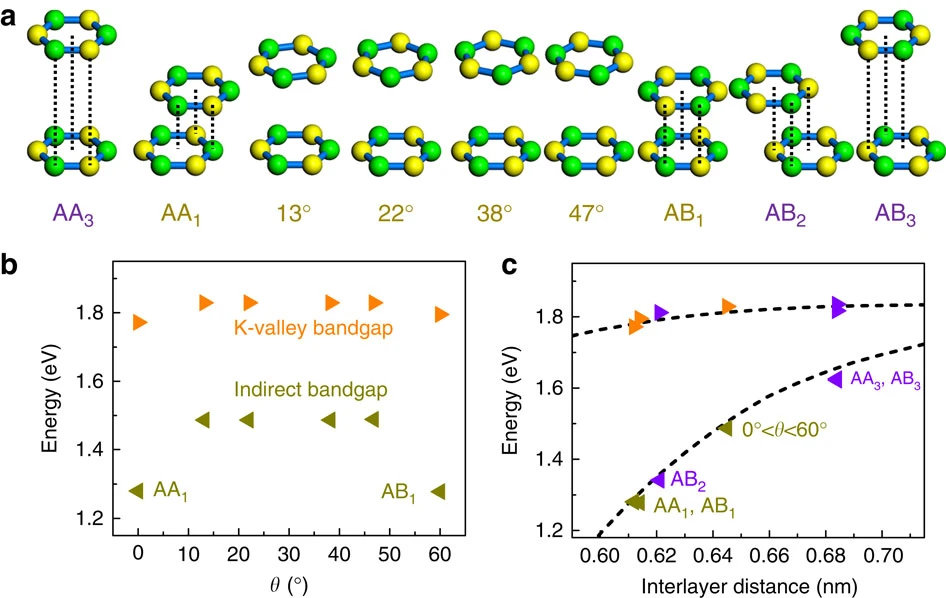
The Figure 4 shows the twisted bilayer MoS2 configurations.
2. Load and preview MoS2 structure
First, we navigate to Materials Designer and import the MoS2 material from the Standata.
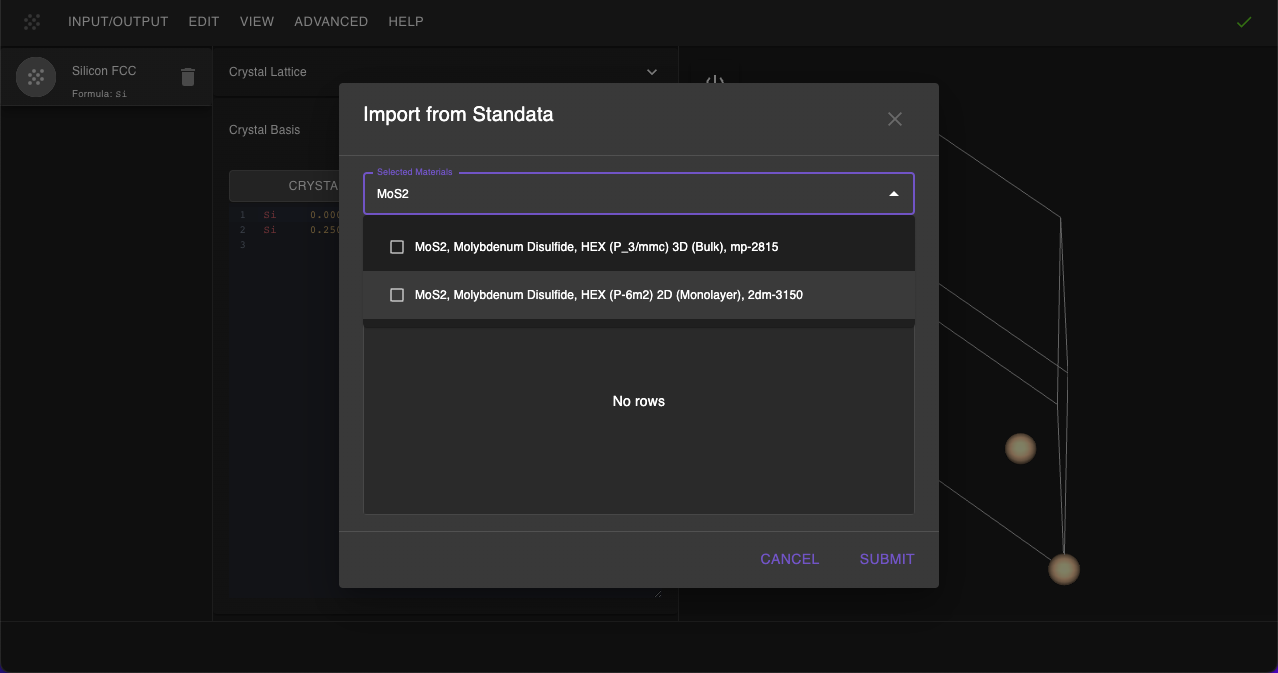
Then we will use the JupyterLite environment to create a twisted bilayer molybdenum disulfide structure.
3. Create the MoS2 bilayers
3.1. Launch JupyterLite Session
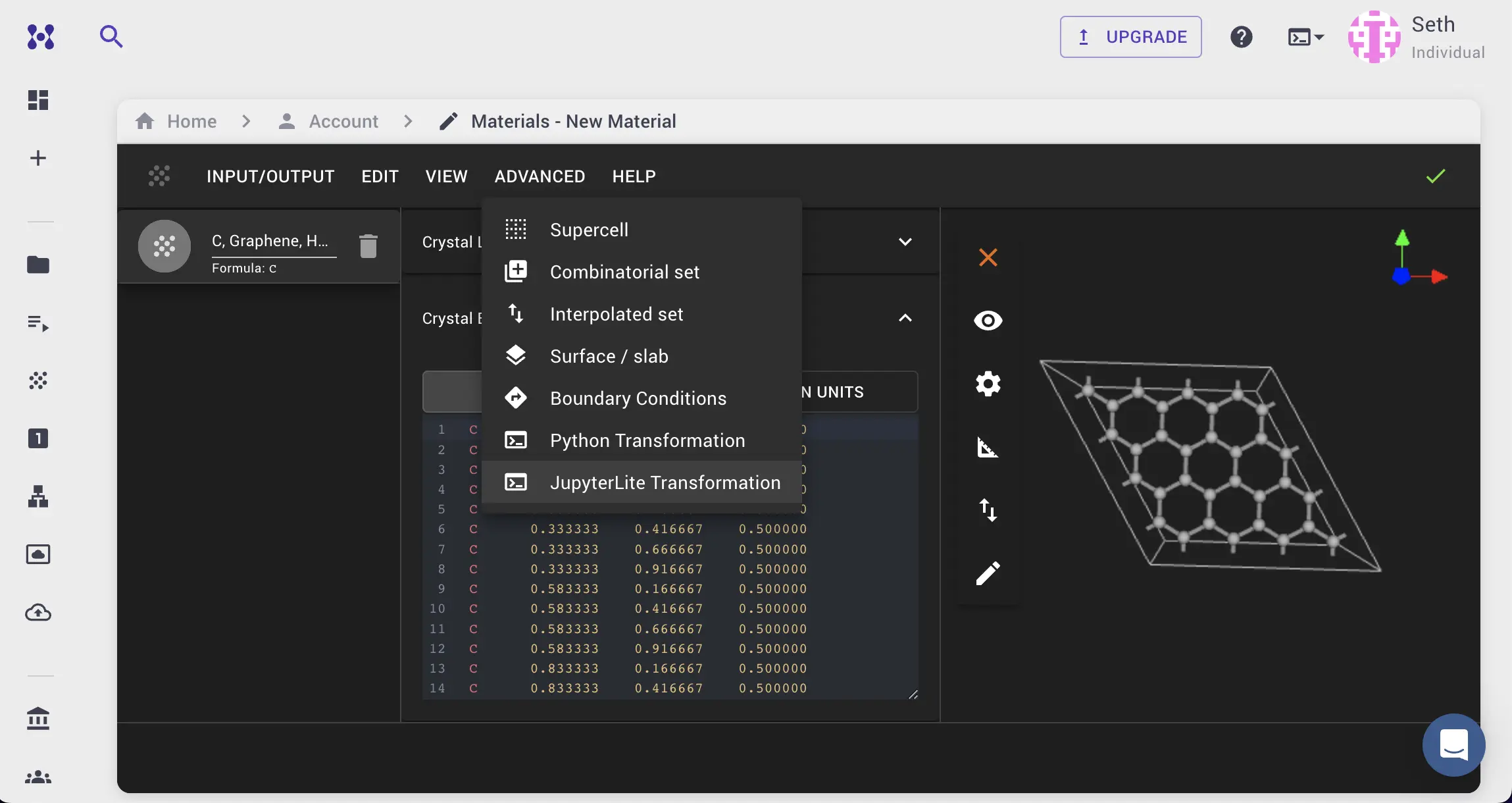
Select the "Advanced > JupyterLite Transformation" menu item to launch the JupyterLite environment.
3.2. Open and modify the notebook
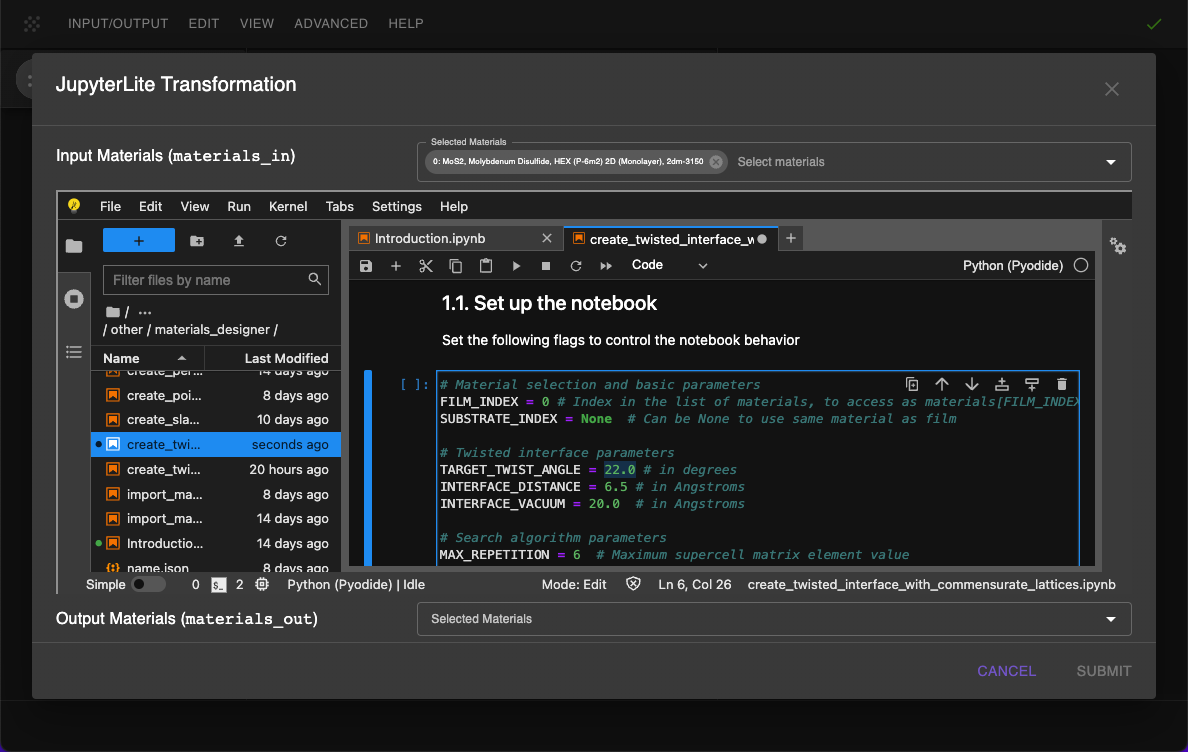
Open specific_examples/interface_bilayer_twisted_commensurate_lattices_molybdenum_disulfide.ipynb
— the notebook embedded in section 5 below.
The first cell lists the configurations to build. Each entry is a name, a twist angle, and an interlayer separation; the notebook builds every active entry in one run, so there is no need to edit and re-run once per angle:
1 2 3 4 5 6 7 8 9 | |
d_mo_mo is the Mo–Mo separation, not a gap
Table S1 of the manuscript tabulates the averaged Mo–Mo separation of the two layers, and
d_mo_mo is that quantity. The notebook subtracts the monolayer thickness itself to get the gap
the builder needs. Passing 6.5 Å straight through as a gap would put the layers roughly 3 Å
further apart than the manuscript, which is enough to change the indirect gap substantially.
The second cell holds the cell and search parameters:
1 2 3 4 5 6 7 8 9 10 11 12 13 14 | |
TOTAL_CELL_HEIGHT is the total out-of-plane cell dimension, matching the 20 Å the manuscript
used to separate the bilayer from its periodic images. The notebook derives the vacuum from it, so
the built cell comes out at 20 Å regardless of which interlayer separation is requested.
3.3. Run the Notebook
After setting the parameters, run the notebook to build every active configuration.

3.4. Check the geometry
For each structure the notebook prints the atom count, the achieved Mo–Mo separation next to the value that was asked for, the cell height, and — for the registered stacks at 0° and 60° — which stacking registry the search actually produced:
1 2 | |
The registry matters because Table S1 gives a different interlayer distance to each one: 6.1–6.2 Å for the AA1/AB1 and AA2/AB2 stacks, 6.8 Å for AA3/AB3 where sulfur sits directly over sulfur.
3.5. View results and pass to Materials Designer
The generation might take some time. Each finished structure is saved to the uploads folder under
its name, and can also be passed to the Materials Designer for further analysis.
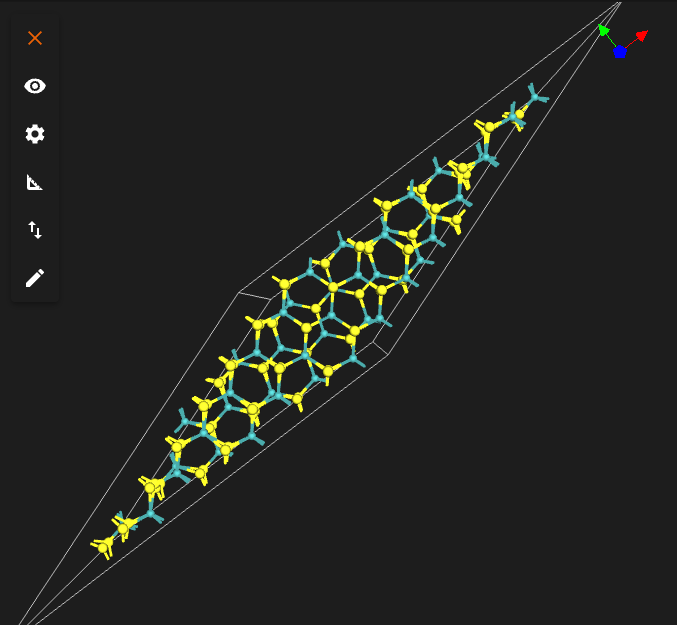
The interface for the 21.8° twist is shown below.
4. The other twist angles
The remaining configurations are already in INTERFACE_PARAMETERS, commented out. Uncomment the
ones needed and re-run; the separations come from Table S1 of the manuscript.
| Entry | Angle | d_mo_mo |
Atoms |
|---|---|---|---|
MoS2 bilayer AA3 d6.8 |
0° | 6.8 Å | 6 |
MoS2 bilayer 13.2deg d6.5 |
13.2° | 6.5 Å | 114 |
MoS2 bilayer 21.8deg d6.5 |
21.8° | 6.5 Å | 42 |
MoS2 bilayer 38.2deg d6.5 |
38.2° | 6.5 Å | 42 |
MoS2 bilayer 46.8deg d6.5 |
46.8° | 6.5 Å | 114 |
MoS2 bilayer AB1 d6.1 |
60° | 6.1 Å | 6 |
The 13.2° and 46.8° cells hold 114 atoms and take noticeably longer to build than the rest.
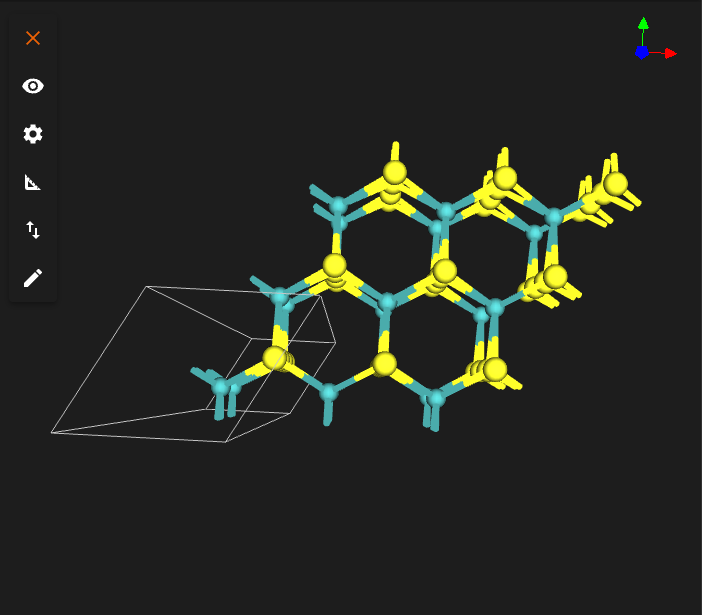
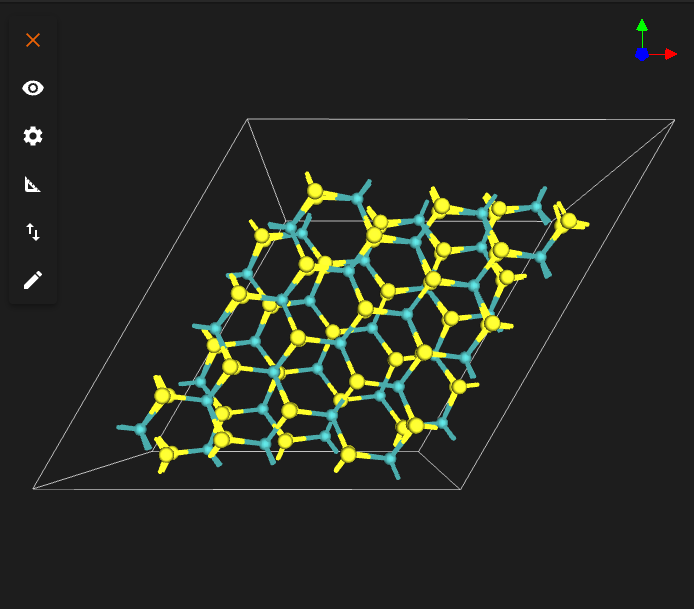
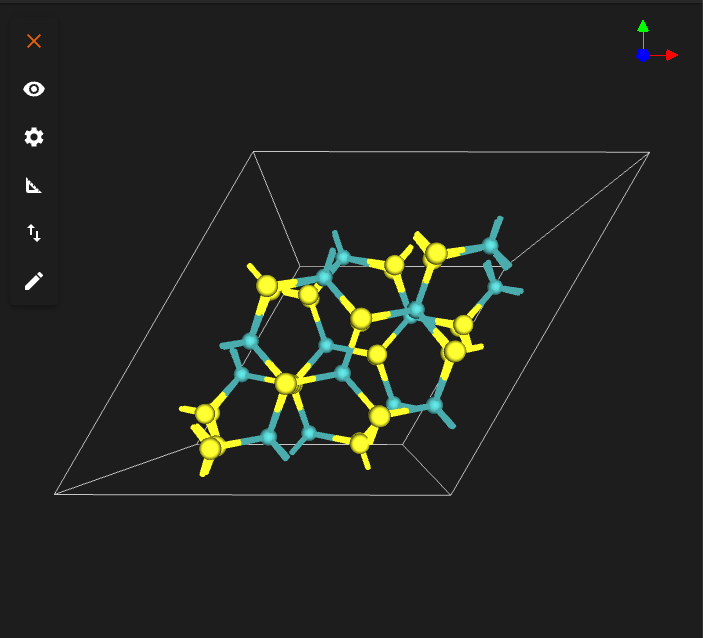
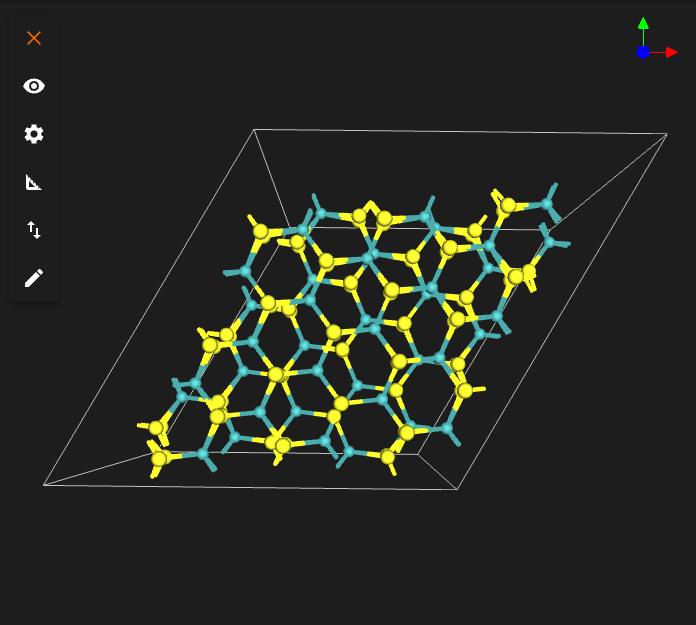
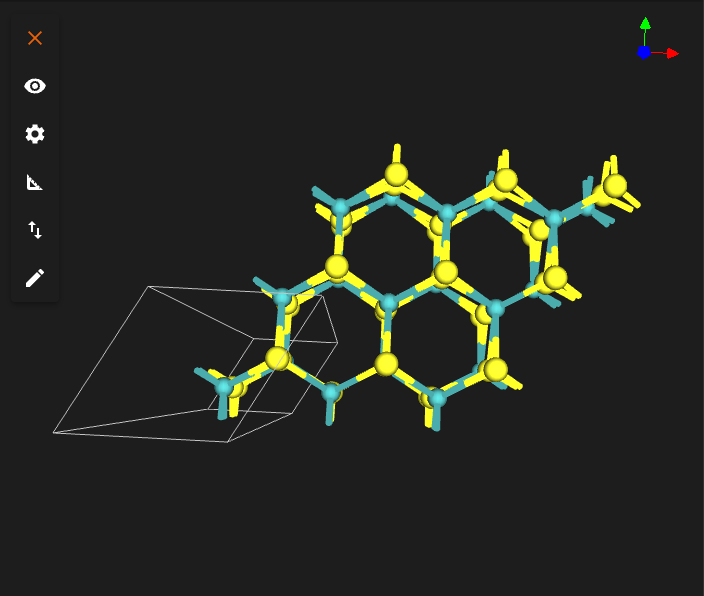
Once the structures exist, the band structure tutorial loads them by name and reproduces the manuscript's band gaps.
5. Interactive JupyterLite Notebook
The interactive JupyterLite notebook for creating twisted bilayer MoS2 structures can be accessed below. To run the notebook, click on the "Run All" button.
6. References
-
Kaihui Liu, Liming Zhang, Ting Cao, Chenhao Jin, Diana Qiu, Qin Zhou, Alex Zettl, Peidong Yang, Steve G. Louie, and Feng Wang. Evolution of interlayer coupling in twisted molybdenum disulfide bilayers. Nature Communications, 5:4966, 2014. URL: https://doi.org/10.1038/ncomms5966, doi:10.1038/ncomms5966. ↩
-
Y. Cao, V. Fatemi, S. Fang, and et al. Unconventional superconductivity in magic-angle graphene superlattices. Nature, 556:43–50, 2018. URL: https://doi.org/10.1038/nature26160. ↩