Calculate Valence Band Offset
This tutorial explains how to calculate the valence band offset (VBO) based on the potential lineup method 1 2 3 using Density Functional Theory (DFT). The example system is a 2D material interface MoS2/WS2, and Quantum ESPRESSO is used as the simulation engine. The content of this tutorial was also presented in the 2021 webinar 2D Materials and their Electronic Properties 4.
Simulation engine
The VBO workflow is currently only available for Quantum ESPRESSO.
1. Understand the method
1.1. Valence band offset
The valence band offset is defined by the relative position of the valence band on both sides of an interface. This property is relevant for studying charge transport across interfaces such as semiconductor heterojunctions. Related properties include the conduction band offset and the Schottky barrier (metal-semiconductor interface).
1.2. Potential lineup method
This tutorial employs the potential lineup method to determine the VBO, which requires the macroscopically averaged electrostatic potential and valence band maximum of the two materials. The VBO for an A/B interface is:
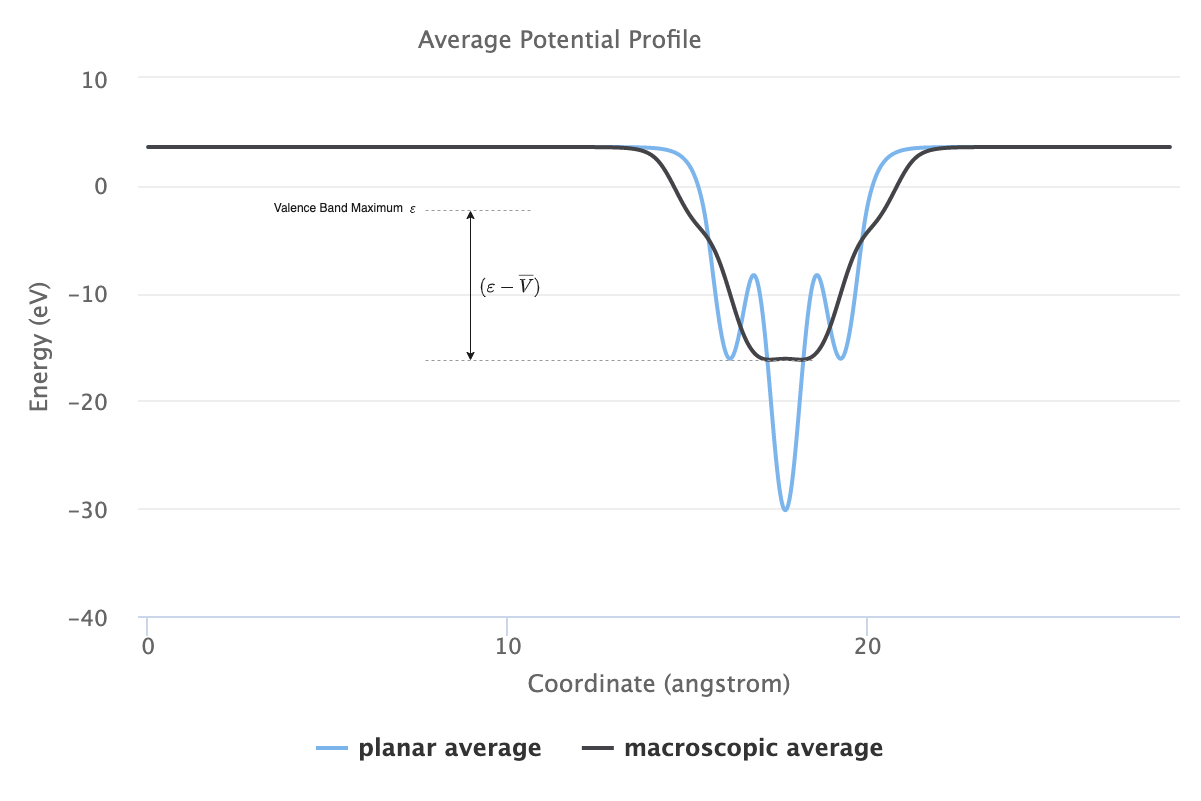
The first term, \(\Delta E_{v}\), is the band structure term — the difference of the two valence band maxima \(\varepsilon_{v}\) referenced to the macroscopically averaged electrostatic potential \(\overline{V}\) in each material:
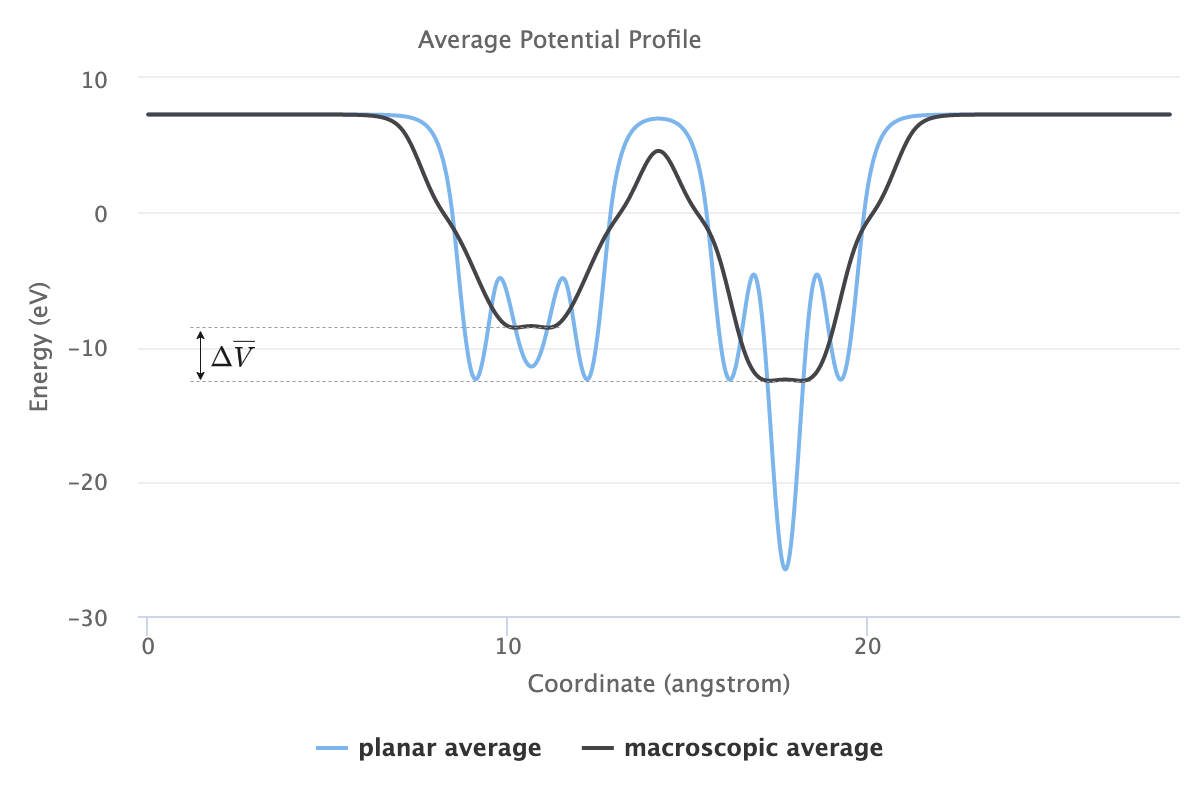
The second term, \(\Delta \overline{V}\), is determined from the lineup of the macroscopically averaged electrostatic potential in the interface heterostructure.
2. Select the materials
Three materials are required, corresponding to the MoS2/WS2 interface and the isolated monolayers of both MoS2 and WS2. Each structure should be relaxed beforehand.
The initial interface structure was taken from materialsproject.org and optimized via variable-cell relaxation of the x- and y-components. The monolayer structures were extracted from the interface and optimized in the same way. The final structures are available on the Mat3ra platform:
Material order
The VBO workflow assumes the interface structure corresponds to the first material. The interface structure must be loaded first.
3. Select the workflow
The workflow for calculating the VBO can be imported from the Workflows Bank into the account-owned collection. The workflow can then be selected and added to the job being created.
A representation of this workflow is also available in the Mat3ra workflow definitions repository (wode.js).
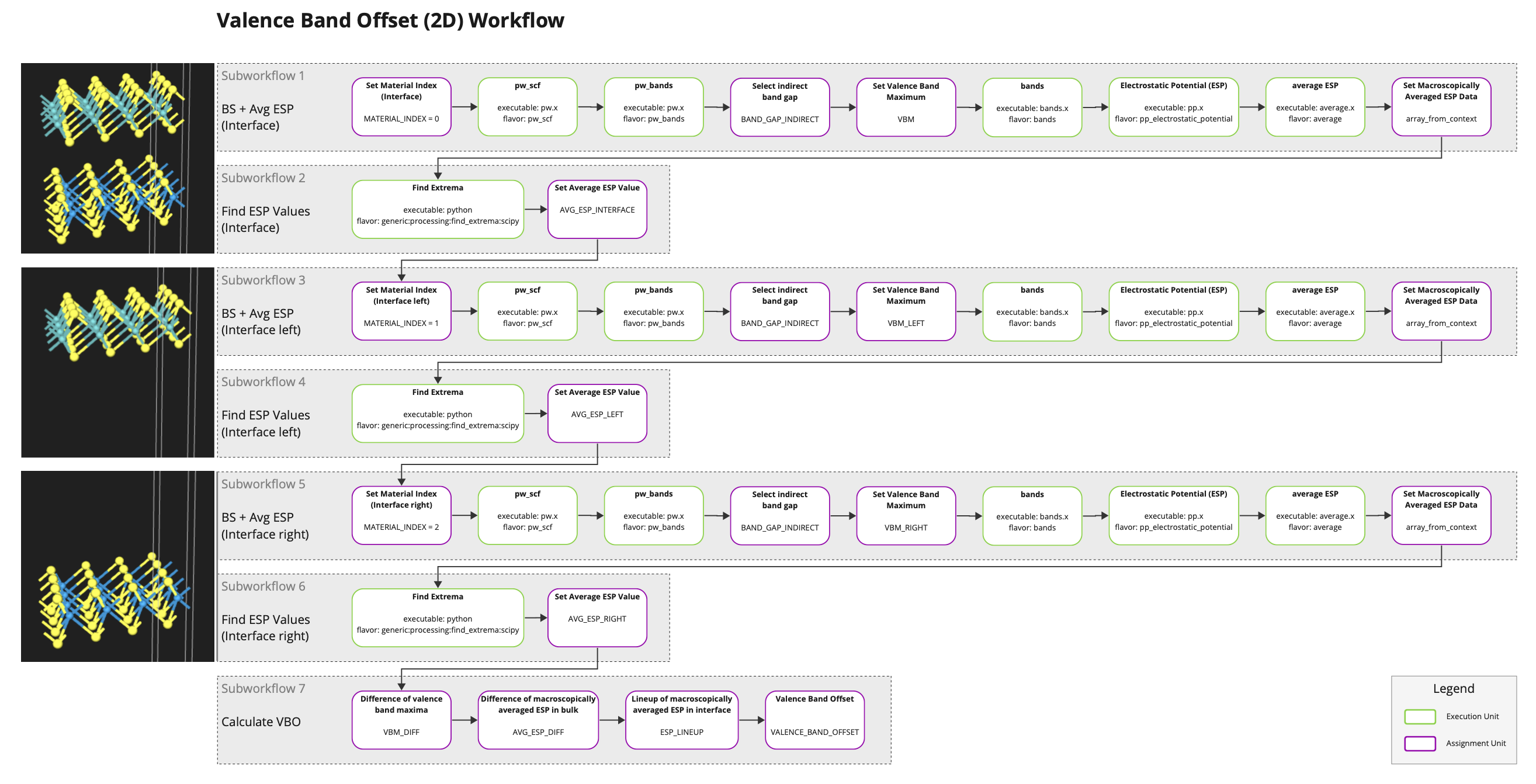
The workflow contains two subworkflows per material that calculate the valence band maximum (via band structure), the macroscopically averaged electrostatic potential, and its minima. For monolayer heterostructures, determining \(\overline{V}\) in the monolayer region corresponds to finding the minima. For multilayered heterostructures, the problem becomes equivalent to finding plateaus of \(\overline{V}\). The final subworkflow collects all intermediate results and determines the VBO.
3.1. Configure workflow settings
Set the k-point grid to 6 × 6 × 1 for each of the three PW-SCF units and adjust the k-path to reflect the reduced dimensionality (Γ–M–K–Γ). Also adjust the macroscopic averaging window size — for this system, set it to the distance between the sulfur atoms in both monolayers (~5.7 bohr).
4. Submit the job
Before submitting the job, the Compute tab of Job Designer should be reviewed to verify the compute parameters.
5. Examine the results
Once all unit computations complete, the Results tab of Job Viewer displays the VBO as well as the plots of the planar and macroscopic average of the electrostatic potentials.
5.1. Compare with experiment
The calculated value of ~0.27 eV is below the experimental value of 0.55 eV 5, but agrees with previous theoretical results of 0.32 eV and 0.22 eV 6.
6. Video walkthrough
The animation below demonstrates the steps involved in creating and executing a VBO workflow.
7. Links
-
A. Baldereschi, S. Baroni, R. Resta, Phys. Rev. Lett. 61, 734 (1988); DOI: 10.1103/PhysRevLett.61.734 ↩
-
L. Colombo, R. Resta, S. Baroni, Phys. Rev. B 44, 5572 (1991); DOI: 10.1103/physrevb.44.5572 ↩
-
M. Peressi, N. Binggeli, A. Baldereschi, J. Phys. D: Appl. Phys. 31, 1273-1299 (1998); DOI: 10.1088/0022-3727/31/11/002 ↩
-
2D Materials and their Electronic Properties (Mat3ra YouTube) ↩
-
C. Lu, et al., Phys. Status Solidi A, 1900544 (2009); DOI: 10.1002/pssa.201900544 ↩
-
E. Torun, H.P.C. Miranda, A. Molina-Sánchez, L. Wirtz, Phys. Rev. B 97, 245427 (2018); DOI: 10.1103/PhysRevB.97.245427 ↩