Phonon Dispersions and Density of States on Grid
This tutorial explains how to calculate the Phonon Dispersion Curves and Phonon Density of States of crystalline silicon using the Grid Method with Quantum ESPRESSO.
Quantum ESPRESSO version
This tutorial applies to Quantum ESPRESSO versions 5.2.1, 5.4.0, 6.0.0, 6.3, and later.
The Grid Method is based on a map type workflow where multiple branches execute in parallel as separate jobs, providing faster overall phonon calculations. More information and results on a sample material set are available in Ref. 1. For the alternative serial approach, see the standard phonon tutorial.
1. Understand the Grid Method
The Grid Method parallelizes the computation of individual vibrational modes by optimizing the workflow to calculate frequencies for each symmetry-irreducible representation 2 of phonon lattice perturbations in parallel.
The workflow follows a map-reduce pattern:
- Irreducible representations (irreps) are generated based on the q-point grid.
- A separate calculation is prepared and submitted for each irrep-q-point pair via a Map (map stage).
- After all pair calculations complete, the dynamical matrices are collected and aggregated, and phonon dispersions and DOS are calculated (reduce stage).
The limiting factor is the longest run per individual irrep-q-point pair.
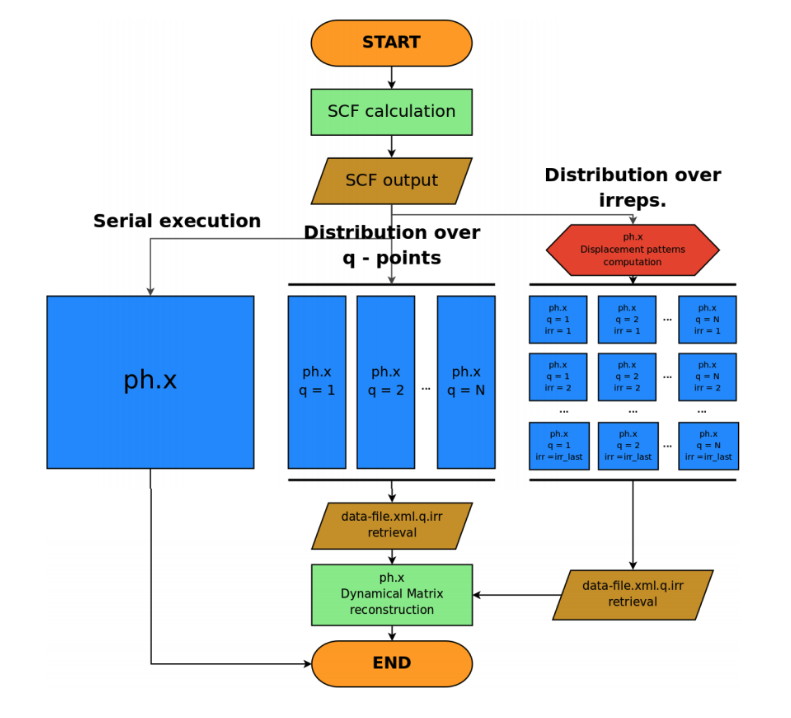
2. Understand the workflow structure
The workflow contains five main subworkflow steps:
2.1. Preliminary SCF calculation
A standard self-consistent field (SCF) total energy calculation provides the wavefunctions. The k-point grid is set to 6 × 6 × 6 under Important Settings.
2.2. Q-points and irrep generation
The "ph-init-qpoints" subworkflow generates the q-point grid over which phonon calculations are performed. The q-grid must be a divisor of the k-grid — a q-grid of 2 × 2 × 2 is appropriate here.
2.3. Extract q-point/irrep pairs
The "espresso-xml-get-qpt-irr" subworkflow uses a Python script to parse and extract q-points and irreducible representations from the Quantum ESPRESSO XML data.
2.4. Map distributed phonon calculation
The Map subworkflow distributes parallel phonon calculations across each q-point/irrep pair. The q-grid under the "Important Settings" of the "ph-single-irr-qpt" map subworkflow should also be set to 2 × 2 × 2.
2.5. Reduce and aggregate results
The final "Reduce" subworkflow collects results from all independent pair calculations via "ph_grid_restart". The q-grid under Important Settings should again be 2 × 2 × 2. Results are then processed through the Quantum ESPRESSO "q2r" and "matdyn" executables.
3. Create and submit the job
"Phonon Map" workflows can be imported from the Workflows Bank into the account-owned collection. Follow the same instructions as in the standard phonon tutorial for creating and launching the job and inspecting results.
4. Video walkthrough
The animation below demonstrates the Grid Method phonon calculation on crystalline silicon using Quantum ESPRESSO.
Computational cost
Phonon calculations are computationally demanding. At least 8 computing cores are recommended. For larger calculations, OF queues offer faster turnaround than OR queues.