Vacancy-Substitution Pair Defects in GaN (Formation Energy)
1. Introduction
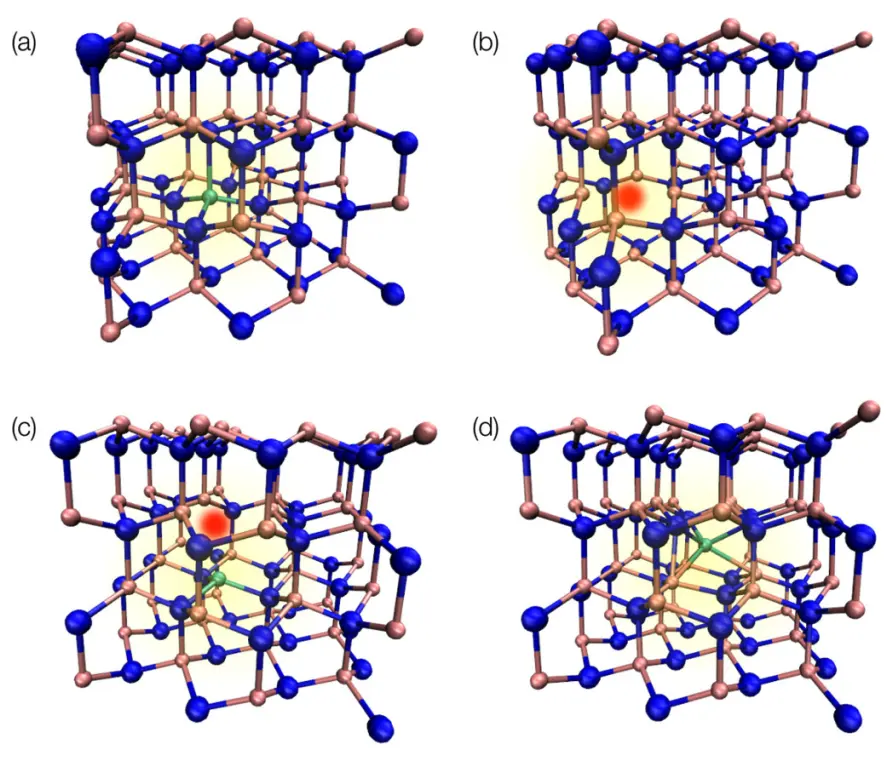
This tutorial calculates the formation energy E_f of the neutral Mg_Ga-V_N defect pair in GaN, reproducing results from the following manuscript:
Manuscript
Giacomo Miceli and Alfredo Pasquarello, "Self-compensation due to point defects in Mg-doped GaN", Physical Review B 93, 165207 (2016). DOI:10.1103/PhysRevB.93.165207. 1
This tutorial builds upon the Vacancy-Substitution Pair Defects in GaN tutorial, where the defective structure is created. Here, the formation energy is calculated using Quantum ESPRESSO at the Ga-rich and the N-rich limits, and compared with Table I of the manuscript.
The figure below shows FIG. 2 of the manuscript; the pair computed here is panel (c):
2. Prerequisites
Before starting this tutorial, one of the following steps should be completed:
- Follow the Vacancy-Substitution Pair Defects in GaN tutorial,
using the
defect_point_pair_gallium_nitride.ipynbnotebook embedded in its section 8, to create and saveGaN 3x3x2 Mg_Ga-V_N axial pair, OR - Have the material saved in the
uploadsfolder or in the account's materials collection
The GaN unit cell (the pristine reference) and the chemical-potential references Ga (mp-142), solid N₂ (mp-154) and Mg₃N₂ (mp-1559) are loaded from Standata.
3. Workflow overview
The defect formation energy calculation consists of the following steps:
- Set up the environment and parameters: Configure material names, the energy k-grid, the Density Functional Theory (DFT) model, and compute resources
- Authenticate and initialize API client: Connect to the platform
- Load materials: Import the pair and the four Standata references, print their compositions and the Mg-N distances
- Configure the model and k-grids: One DFT model, a relaxation and an energy k-grid per material
- Configure compute resources: Select the cluster, queue, and processor settings
- Relax every cell: At fixed cell, reusing a relaxed structure if one is found
- Compute total energies: One Total Energy job on each relaxed structure
- Retrieve results: Print the chemical potentials, the formation enthalpy of GaN, and E_f at each limit
- Compare with the manuscript: Print our values beside Miceli & Pasquarello's
4. Calculation parameters
| this tutorial | Miceli & Pasquarello | |
|---|---|---|
| Code | Quantum ESPRESSO | Quantum ESPRESSO |
| Functional | Perdew-Burke-Ernzerhof (PBE) | Heyd-Scuseria-Ernzerhof (HSE), 31 % Fock exchange |
| Pseudopotentials | ultrasoft (GBRV), Ga 3d in valence | norm-conserving, Ga 3d in core |
| Cutoff | 40 / 200 Ry | 45 Ry |
| Cell | 3×3×2, 71 atoms with the pair; pristine as 18 GaN unit cells | 96 atoms |
| k-points, pair | Γ for the relaxation, ENERGY_KGRID for the energy |
Γ for the relaxation, 2×2×2 for the energy |
| μ_N, N-rich limit | solid N₂ (mp-154) | N₂ molecule |
| μ_Mg | Mg₃N₂ equilibrium, Mg₃N₂ (mp-1559) | Mg₃N₂ equilibrium |
| Relaxation | atoms only, fixed cell, 0.05 eV/Å | "fully relaxed"; cell and threshold not stated |
| Spin | spin-restricted, the neutral pair being closed-shell (0.00 μB) | spin-unrestricted where unpaired electrons occur |
A relaxed structure already in the account is reused whatever model produced it, and its name is printed; a model change therefore does not trigger a fresh relaxation.
5. Step-by-step instructions
5.1. Open the notebook
Navigate to the API examples repository and open the defect formation energy notebook:
1 | |
5.2. Configure parameters
The parameters cells set the material names, the energy k-grid, the compute resources, and the DFT model:
1 2 3 4 5 6 7 8 9 10 11 12 13 14 15 16 17 18 19 20 21 22 | |
5.3. Run the notebook
Execute all cells by selecting Run > Run All from the menu.
The notebook first authenticates with the platform, then runs the steps listed in section 3.
5.4. Monitor progress
The notebook polls the jobs every 60 seconds (POLL_INTERVAL) and marks each reused structure or job
♻️. Measured on cluster-001, 16 cores in the OR queue, as job time without the queue: from scratch about
2 h 10 min (default ENERGY_KGRID) and 1 h 50 min ([1, 1, 1]), longer than one login lasts (section
8.3); with the relaxations reused, about 35 and 12 min (the default run took 42 min with the queue);
with every job finished, about a minute.
5.5. Analyze results
The last cell prints E_f at each limit and the formation enthalpy |ΔH_f(GaN)| beside the manuscript's
values, here for the default ENERGY_KGRID:
1 2 3 | |
6. Expected results
Table I of the manuscript gives the formation energy of the neutral pair, computed with HSE with the
Fermi level at the valence band maximum, as 1.2 eV (Ga-rich) and 2.1 eV (N-rich). Table I labels this row
and the q = +2 row (−0.4 / 0.5 eV) both E_f^{+2}, in the published version and in the arXiv source.
FIG. 3 resolves it: the pair's line rises with slope +2 from −0.4 / 0.5 eV and is flat at 1.2 / 2.1 eV
above the +2/0 transition at E_F = 0.80 eV, so the flat values are the neutral ones. Only the neutral pair
is compared. The formation enthalpy, |ΔH_f(GaN)| = 1.4 eV, is Table I's V_N rows, 4.7 eV (N-rich) − 3.3 eV (Ga-rich).
6.1. Comparison with published results
| E_f, N-rich (eV) | E_f, Ga-rich (eV) | |ΔH_f(GaN)| (eV) | |
|---|---|---|---|
| Miceli & Pasquarello, HSE | 2.1 | 1.2 | 1.4 |
ENERGY_KGRID = [4, 4, 3] (default) |
2.185 (+4 %) | 1.570 (+31 %) | 0.922 (−34 %) |
ENERGY_KGRID = [1, 1, 1] (fast) |
1.066 (−49 %) | 0.550 (−54 %) | 0.773 (−45 %) |
7. Customization options
7.1. Choose the energy k-grid
ENERGY_KGRID is the k-grid of the pair's total energy; the GaN unit cell's follows it, multiplied by
SUPERCELL_KGRID. [1, 1, 1] is faster and not converged:
1 | |
Both values share the relaxations: switching re-runs only the pair's and the GaN unit cell's Total Energy jobs. The manuscript's own mesh, 2×2×2 on its 96-atom cell, is untested here.
7.2. Adjust computational resources
The default, CLUSTER_NAME = None, uses the account's first listed cluster; setting a specific name picks
that cluster instead, and a name that is not available makes the notebook stop and list the ones that are.
7.3. Use the manuscript's settings
The functional stays PBE: HSE on these cells exceeded the platform's time and memory. The other settings can be moved toward the manuscript's in the parameters cells:
- Pseudopotentials: set
PSEUDOPOTENTIAL_TYPE = "nc", at a cutoff untested here; the manuscript's 45 Ry does not transfer, an HSE job with PseudoDojo norm-conserving at 45 Ry giving forces up to 0.68 eV/Å on the perfect crystal. The platform's norm-conserving Ga keeps 3d in valence, unlike the manuscript's - Cell: build a 96-atom cell with
SUPERCELL_MATRIXin the structure notebook and save the pair under a new name there; here, setDEFECTIVE_NAMEto that name and fold the cell's k-grid inSUPERCELL_KGRID - Spin: in section 7 of the notebook, patch
{"nspin": 2, "starting_magnetization(2)": 0.5}(species 2 = N) into the pair's&SYSTEMwithpatch_workflow_qe_inputand change itsworkflow.name: the name does not carrynspin, so under the old name the finishednspin = 1job is reused
8. Troubleshooting
8.1. Material not found
If GaN 3x3x2 Mg_Ga-V_N axial pair is not found in the uploads folder or the account's materials
collection, run the Vacancy-Substitution Pair Defects in GaN
tutorial first, and check that its uploads folder holds the pair under that exact name. If
Mg3N2-[Magnesium_Nitride]-BCC_[Ia-3]_3D_[Bulk]-[mp-1559] is not found, update mat3ra-standata to a
release that includes the entry.
8.2. No cluster available, or jobs end in error
If section 5.1 of the notebook prints an empty list of clusters, there is nothing to submit to, and
section 5.2 stops with IndexError: list index out of range. A cluster has to be available to the
account before the notebook can run. If the relaxations end in error on the default cluster, section 7
of the notebook stops with RuntimeError: Job … reported no 'final_structure'. Set CLUSTER_NAME to
another cluster — cluster-001 ran every job here — and re-run; finished jobs are reused.
8.3. No formation energy on the first run
The platform's access token lasts one hour and expires during the Mg₃N₂ relaxation: on a first run from
scratch, the wait in section 6 of the notebook stops with HTTPError 401: You must be logged in. The jobs
keep running. About 1 h 40 min after the start, restart the kernel and run all cells again (Kernel >
Restart Kernel and Run All Cells): the notebook asks for a new login and picks up the running and
finished jobs.
8.4. Formation energy far from the published value
Check the provenance printed in section 3 of the notebook first. The pair is 71 atoms, Ga 35 / N 35 / Mg 1, with three Mg-N bonds at 1.968 Å:
1 2 | |
9. Interactive JupyterLite notebook
The following JupyterLite notebook demonstrates the workflow for calculating the formation energy of the Mg_Ga-V_N pair in GaN. Select Run > Run All Cells.
10. References
-
Giacomo Miceli and Alfredo Pasquarello. Self-compensation due to point defects in mg-doped gan. Physical Review B, 93:165207, 2016. URL: https://link.aps.org/doi/10.1103/PhysRevB.93.165207. ↩